Facilitation and Field Demonstration of Arecanut Husk Compost Culture for the first time in Goa by ICAR-CCARI, Old Goa
Facilitation and Field Demonstration of Arecanut Husk Compost Culture for the first time in Goa by ICAR-CCARI, Old Goa
Challenge
Under the National Campaign on Balanced Fertilization, proper management of crop residues is a critical component for sustainable soil health. In arecanut-growing regions, managing the massive volume of crop waste poses a significant challenge, with one acre of arecanut producing up to 1.2–1.5 tonnes of husk annually. Due to high concentrations of lignin (28%) and hemicellulose (28%), this husk is highly resistant to natural decay, taking anywhere from one to three years to decompose on its own. To solve this bottleneck, the University of Agricultural and Horticultural Sciences, Shivamogga, has developed a specialized compost culture that dramatically accelerates the breakdown process, converting the tough husk into nutrient-rich compost in six months. This highly efficient culture requires only 2–4 kg of inoculum per truckload of husk and is highly cost-effective at approximately ₹120 per kg. Ultimately, this intervention not only eliminates the need for residue burning but also yields a high-quality final compost that is naturally rich in Potash, providing an excellent organic input for balanced crop nutrition.
Initial Awareness & Digital Extension
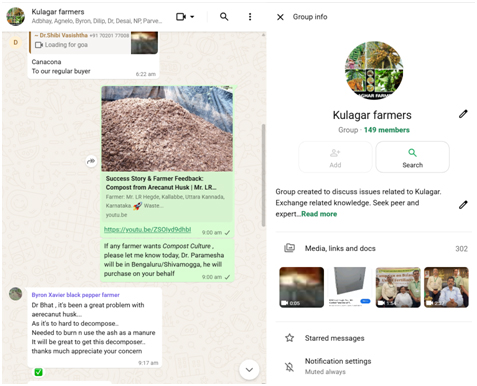
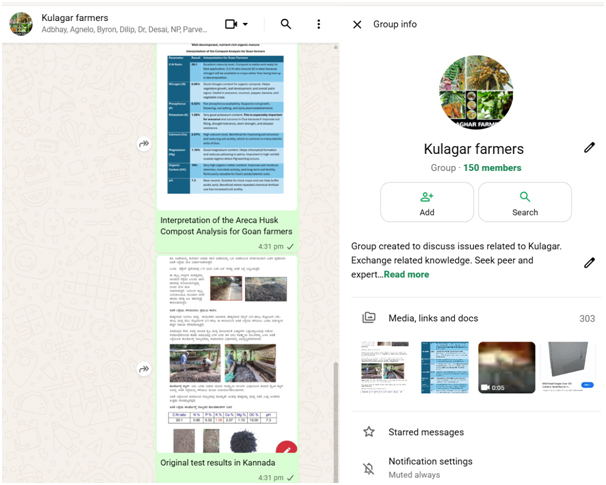
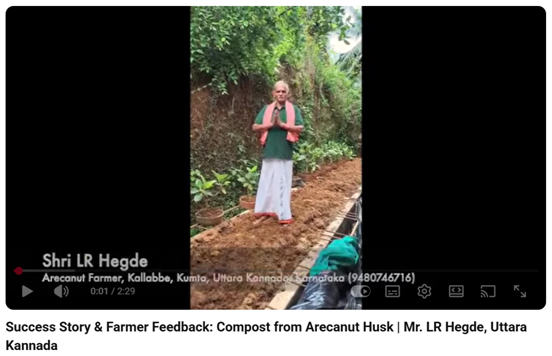
To build initial momentum, a success-story video showcasing the practical application of this compost culture by a progressive farmer in the neighbouring Uttara Kannada district was shared across Kulagar WhatsApp group. This digital outreach successfully addressed initial apprehension by providing farmers with visual, peer-led proof of the technology's field efficacy (Watch the video: https://www.youtube.com/watch?v=ZSOIyd9dhbI).
Intervention & Procurement Strategy
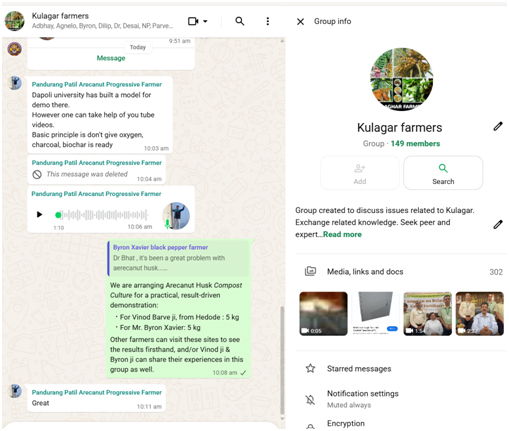
As per the guidance of Dr. Parveen Kumar, Director, ICAR-CCARI, rather than imposing mass upfront procurement, a strategic "Peer-Led Demonstration" model was adopted to maximize the extension impact. Dr. Shripad Bhat facilitated logistics by identifying key progressive farmers for the trials, while Dr. Paramesha coordinated the procurement of authentic, high-quality culture strains.
Field Demonstration Allocations
To establish local proof-of-concept sites, specialized culture will be allocated to key progressive farmers who will serve as benchmark evaluators:
|
S.No. |
Name of the Farmer |
Location |
Quantity Allocated |
Zone / Area |
|
1. |
Mr. Vinod Barve |
Hedode, Sattari, North Goa |
5 kg |
North Goa |
|
2. |
Mr. Byron Xavier |
Bhati, Sanguem, South Goa |
5 kg |
South Goa |
Extension Strategy & Next Steps
The dissemination plan will be executed through the following steps:
- Firsthand Field Visits: Nearby farmers will be invited to visit the trial sites of Mr. Vinod Barve and Mr. Byron Xavier to witness the accelerated rate of husk decomposition firsthand.
- Digital Knowledge Sharing: To accommodate hesitant or distant growers, the host farmers will document the various decomposition stages through photographs and testimonials, sharing their real-time experiences directly within the farmer network group with the help of the Institute.
- Upscaling: Upon successful degradation of the husk at these two benchmark sites, a wider distribution drive will be planned, leveraging organic peer-to-peer demand to drive adoption.This initiative was coordinated by Dr. Shripad Bhat and Dr. Paramesha
https://www.youtube.com/watch?v=ZSOIyd9dhbI